Week 2: Math + Art
As mathematics forms the foundation of the very world we live in, it has always long informed artistic and scientific practice and innovation. Despite one’s seemingly innate rejection of the other, the arts and sciences go hand-in-hand with mathematics. One of the most evident ways that this reality is actualized is through the concept of mathematical perspective. Just as visual art utilizes perspective and geometric principles to play with illusion and dimensionalities, science is also known to use mathematical models and equations to make observations and quantify new theories.
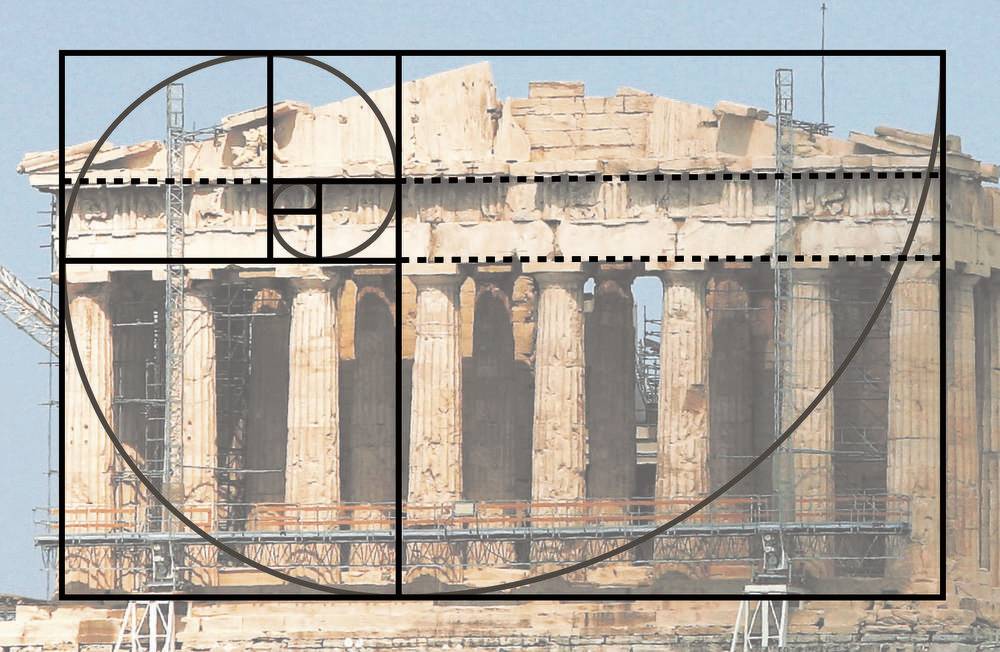
Even stories such as “Flatland,” by Edwin A. Abbott, are creative works that simplify the fundamentals of our reality, which he described in terms of geometric shapes and explanations, especially from a matter of perspective. In understanding a simultaneously mathematical and artistic perspective of the world, we gain a fuller conceptualization of not just abstract pieces of art that transcend perspectives of the second dimension, but also for quantifying art and even beauty. The golden ratio is a mathematical concept long associated with artistic harmony and scientific balance, and is seen in many forms of art from Greek architecture and the Pyramids of Giza to seashell spirals (Reed, 2023). On the topic of dimensionality, however, exploration of the fourth dimension has allowed artists to study and work on depictions founded in mathematics and theoretical physics in order to “depart from visual reality and to reject completely the one-point perspective system” that is dominant in centuries of art beforehand (Henderson, 1984). Artistic movements, such as Cubism, are exemplary of this intersection between art and geometries in order to explore the fourth dimension in ways art of previous centuries had not (Bodish, 2009).
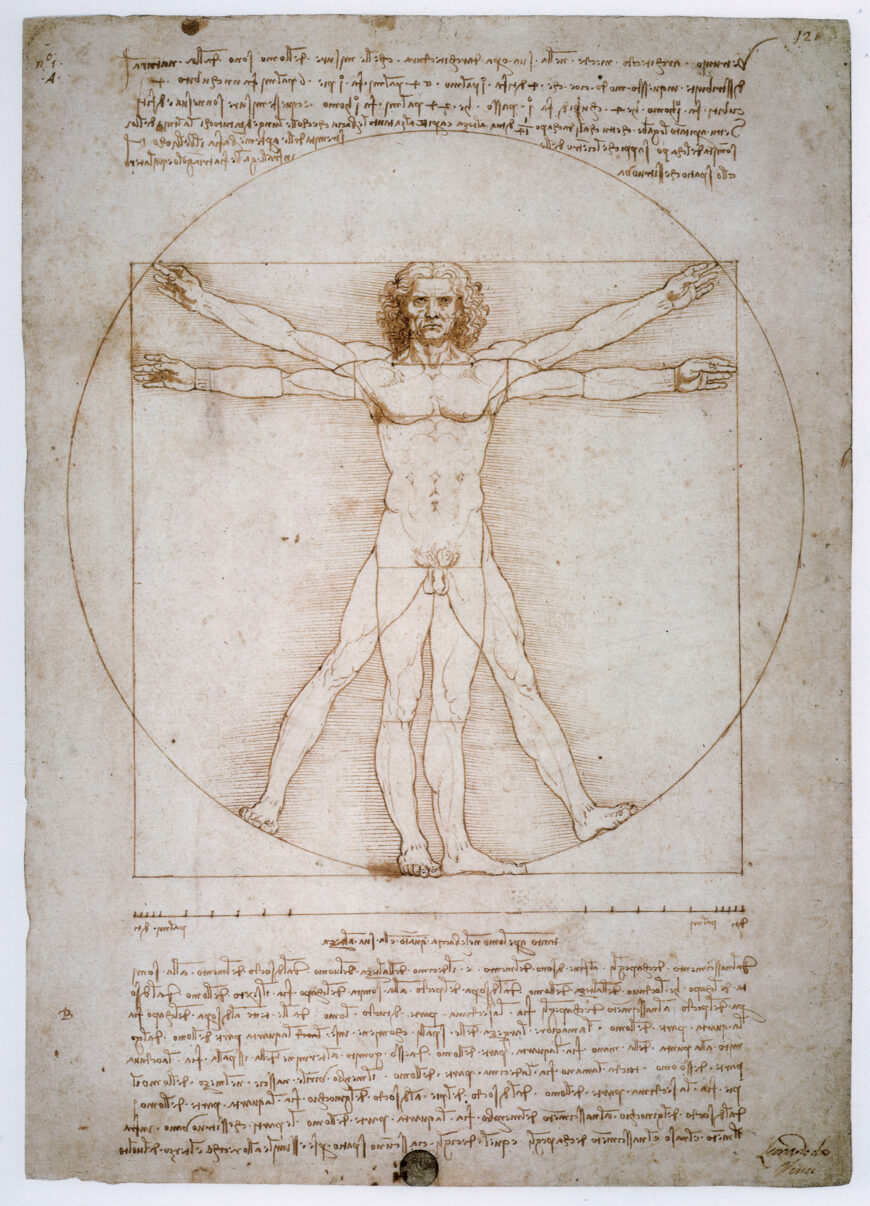
This week’s lecture tells us that Leonardo da Vinci studied the geometry of perspective, both artificially and naturally, and used mathematics and the arts to inform his works. Most notable is his piece The Vitruvian Man, which takes the observations of the architect Marcos Vitruvius to “square a circle,” or “taking the area of a circle and using it to create a square with equal area” (Woloski, 2018).
The juxtaposition of mathematics’ influence on art and science is that although they’re often interpreted as opposite fields with little overlap, one cannot exist without the other, something largely due to mathematical perspectives.
References
Abbot, Edwin A., “Flatland: A Romance of Many Dimensions.” London, Seeley & Co., 1884. Accessed 11 Apr. 2024.
Bodish, Elijah, “Cubism and the Fourth Dimension.” The Mathematics Enthusiast, Vol. 6, No. 3(16). 2009, Accessed 11 Apr. 2024.
Henderson, Linda Dalrymple, “The Fourth Dimension and Non-Euclidean Geometry in Modern Art: Conclusion.” Leonardo, Vol. 17, No. 3. (1984), pp. 205-210. Accessed 11 Apr. 2024.
Reed, Matthew. “The Influence of Golden Ratio in Iconic Paintings.” Handmade Portraits and Reproductions, 1st Art Gallery, 6 Aug. 2023, www.1st-art-gallery.com/article/the-influence-of-golden-ratio-in-iconic-paintings/. Accessed 11 Apr. 2024
Woloski, Leon. “Mathematics in the Art of Leonardo Da Vinci.” Mathnasium, The Math Learning Center, 17 Apr. 2018, www.mathnasium.com/blog/mathematics-in-the-art-of-leonardo-da-vinci. Accessed 11 Apr. 2024.
Photo/ Video References
“Art inspired by mathematics | Michael Naylor | TEDxTrondheim” YouTube, uploaded by TEDx Talks, 4 Dec. 2020. https://www.youtube.com/watch?v=PCzkaEhz9bI. Accessed 11 Apr. 2024
Ch’ien, Dr. Letha, and Dr. Letha Ch’ien. “Leonardo Da Vinci, ‘Vitruvian Man.’” Smarthistory, smarthistory.org/leonardo-da-vinci-vitruvian-man/. Accessed 11 Apr. 2024.
Giannakouris, Petros. “In search of the golden ratio in architecture.” The Associated Press, https://www.theglobeandmail.com/life/home-and-garden/architecture/in-search-of-the-golden-ratio-in-architecture/article20040240/. Accessed 11 Apr. 2024.

Comments
Post a Comment